A drying kiln controller is the automated system that manages temperature, humidity, airflow, and drying schedule execution inside a wood drying kiln. The right controller type depends on your kiln capacity, species mix, and compliance requirements — here is how to choose.
A sawmill operator in Uganda spent three weeks troubleshooting inconsistent moisture content in his 60m3 mahogany charge. The heating system was fine. The fans were working. The problem was his manual controller could not hold wet-bulb depression steady during the critical early drying stages — humidity dropped too fast, surface checks spread across the charge, and the batch was partially lost.
The controller is the brain of the kiln. Without it executing the drying schedule correctly, every other component is just hardware.
Key Takeaways
– A drying kiln controller automates temperature, humidity, fan reversal, and vent management according to a pre-programmed drying schedule
– PLC-based controllers are the correct choice for any operation above 40m3 or requiring ISPM 15 data logging
– Relay-based controllers are simpler and cheaper, but require manual schedule advancement — only suitable for small single-species operations
– Remote monitoring is essential for mills in markets where local kiln expertise is limited
– MC-triggered schedule advancement consistently outperforms time-based advancement when initial moisture content varies between charges — a common condition in mixed tropical hardwood operations
What Does a Drying Kiln Controller Actually Do?
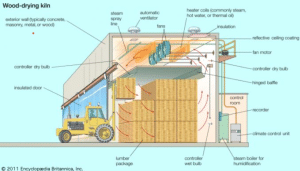
The controller reads two core sensor inputs: dry-bulb temperature (the air temperature inside the kiln) and wet-bulb temperature (measured via a water-wetted sensor). The difference between these two readings — the wet-bulb depression — determines the relative humidity of the kiln atmosphere.
Using these inputs, the controller operates four main components:
- Heating valve: Opens or modulates to raise kiln temperature to the schedule target
- Roof vent dampers: Opens to exhaust humid air when humidity exceeds the schedule limit (managed via Siemens electric damper actuators on Tech Drying kilns)
- Spray system: Injects steam or water mist to raise humidity when the kiln atmosphere drops below the schedule target — critical during heating phases and final conditioning
- Circulation fans: Run continuously to move air through the lumber stack; the controller triggers direction reversals at scheduled intervals to equalize drying across the full charge
More capable controllers also read wood moisture content (MC) probes inserted directly into sample boards, and advance through schedule stages automatically when the wood reaches the target MC — rather than waiting for a preset time to elapse.
Why this precision matters: if the controller allows wet-bulb depression to climb 4-5°C above the schedule target during the first drying stage, the board surface dries faster than the core can release moisture. That shell-to-core gradient creates tensile stress that exceeds the wood’s strength at that MC level, and surface checks form. For dense tropical hardwoods like mahogany or teak, this can happen within the first 24-48 hours of drying — before anyone realizes the schedule is running out of tolerance.
Three Types of Drying Kiln Controllers
| Controller Type | Best For | Schedule Advancement | Data Logging | Remote Access |
|---|---|---|---|---|
| Relay-based (basic) | Small kilns, single species, <30m3 | Manual | No | No |
| PLC-based automatic | Most industrial operations, 30-200m3 | Automatic (MC-triggered) | Yes | Yes |
| Multi-zone computer | Large track kilns, >100m3, multiple zones | Automatic | Full audit trail | Yes |
Relay-Based Controllers
A relay-based controller uses on/off switching to maintain temperature and humidity setpoints. It is simpler to understand, easier to repair without specialist electronics knowledge, and lower in cost.
The limitation is precision. A relay-based system switches fully on or fully off — it does not modulate the heating valve proportionally. This creates temperature oscillation around the setpoint rather than tight control. For tolerant softwood species in a small kiln, this may be acceptable. For dense tropical hardwoods where a 3-5°C swing in the early drying stage causes surface checks, it is not.
Schedule advancement also requires manual operator intervention: someone needs to check the kiln, read the MC, and manually move to the next stage.
PLC-Based Automatic Controllers
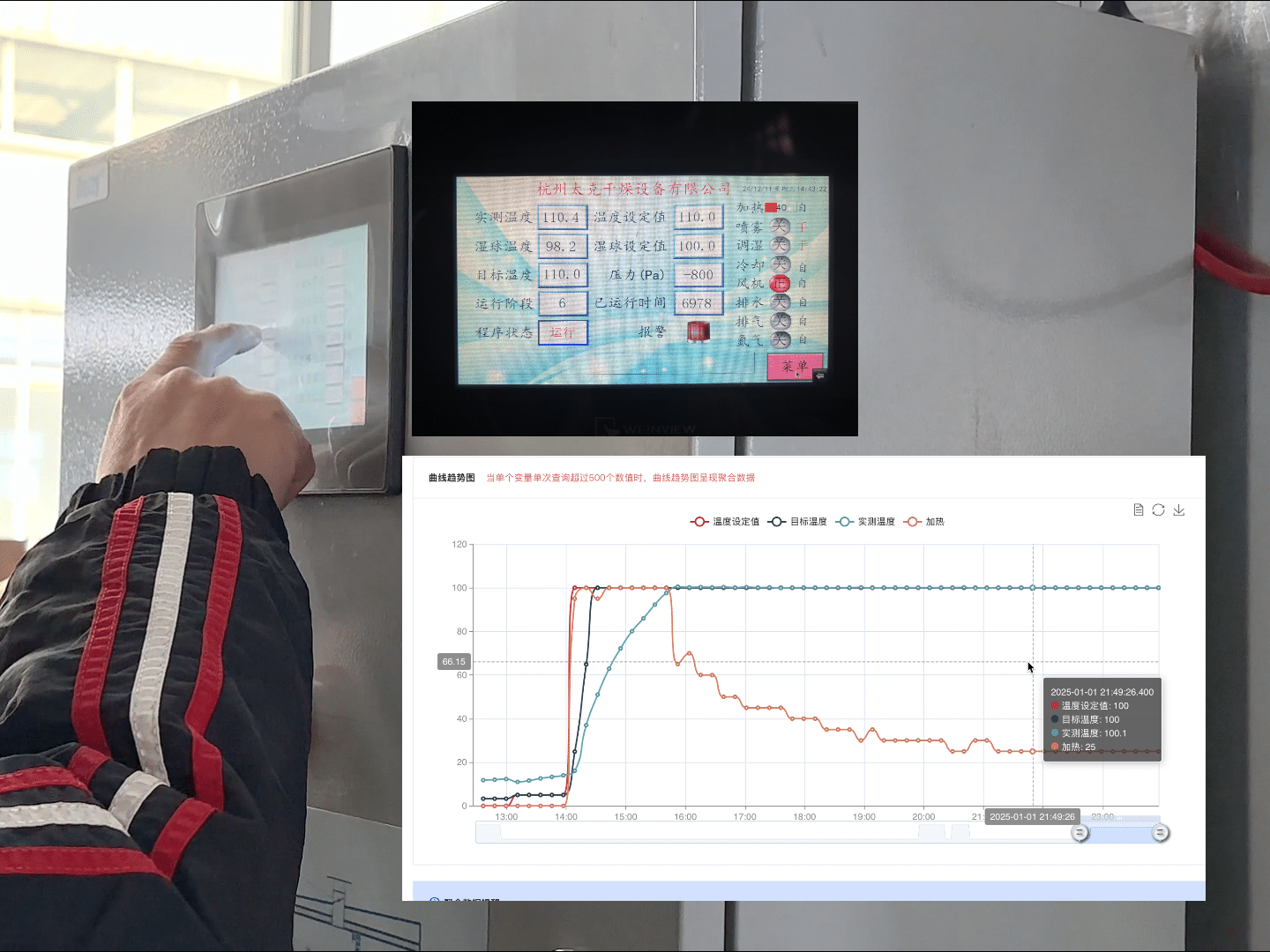
A Programmable Logic Controller (PLC) with a touchscreen HMI is the current standard for industrial wood drying. The PLC uses PID control logic to hold temperature within a tight tolerance, reads wood MC probes to advance schedule stages automatically, logs all drying data throughout the cycle, and provides remote access via mobile or PC.
To make this concrete: a typical early-stage schedule for green hardwood lumber might specify dry-bulb 50°C, wet-bulb depression 3°C, advance to Stage 2 when wood MC drops below 30%. The PLC holds those conditions continuously — modulating the heating valve to maintain 50°C, opening roof vents when the depression exceeds the limit — and triggers the stage change automatically once the MC sensors confirm the transition. No operator intervention needed, no risk of an overnight shift forgetting to advance the schedule.
According to NC State University Wood Products Extension, computerized controls respond to temperature changes faster than older mechanical systems, and PLC-controlled variable-speed fans can automatically adjust airflow as the schedule advances — delivering measurable improvement in drying uniformity across the full lumber stack.
For most sawmill, furniture, and flooring operations in Africa and South Asia, a well-configured PLC system is the correct specification. The Tech PLC Automatic Control System is an example of this tier — 6-12 MC monitoring points per kiln, remote monitoring via mobile and PC, and species schedules pre-loaded before shipment.
Key Features of a Wood Drying Kiln Controller
Not all PLC kiln dryer controllers are equal. When comparing options, prioritize these features:
Drying schedule library: Check how many species programs are included and whether they are field-adjustable. A 20-species library typically covers common temperate species but may not include teak, acacia, or eucalyptus schedules configured for your regional initial MC range. Verify your
MC-triggered schedule advancement: Controllers that advance stages based on actual wood MC — not just elapsed time — produce more consistent results, especially when initial MC varies between charges.
ISPM 15 data logging: If you produce wood packaging or export lumber requiring phytosanitary certification, the controller must log core temperature, treatment duration, and humidity with traceable records. ISPM 15 requires a minimum core wood temperature of 56°C for 30 continuous minutes; documentation of this is mandatory. A controller without this capability cannot support certification.
Remote monitoring: Real-time data accessible via mobile or PC. For mills where the nearest qualified kiln technician is hours away, this allows the equipment manufacturer’s engineering team to monitor and support the kiln remotely.
Alarm notifications: Temperature deviation alarms, sensor failure alerts, and communication loss warnings should push automatically — not require an operator watching the screen.
Matching Controller Type to Your Operation
The right controller depends on four variables: kiln size, species complexity, compliance requirements, and your service environment.
| Operation Profile | Recommended Controller |
|---|---|
| Single-zone, <30m3, one species, no export docs | Relay-based or entry-level digital |
| Single-zone, 30-100m3, mixed species, furniture/flooring output | PLC automatic (standard recommendation) |
| Any kiln used for ISPM 15 heat treatment | PLC with automated temperature/time logging -- mandatory |
| Remote location, limited local electronics service | PLC with strong remote diagnostics and manufacturer support |
| Multi-kiln facility, >100m3 per kiln | Multi-zone computer control |
The controller is a small fraction of total kiln cost — typically 15-20% of the full system. Specifying a relay-based controller to save $3,000-5,000 on a $60,000 kiln investment, then losing 10-15% of a high-value hardwood charge to degrade, is a poor trade.
FAQ
Can I upgrade an existing kiln to a PLC controller?
Yes, in most cases. Upgrading involves replacing the control cabinet and adding or upgrading sensors. Tech Drying has completed controller upgrades on kilns not originally supplied by us. Contact our engineers with your kiln dimensions and heating system type to confirm compatibility.
What controller is required for ISPM 15 compliance?
A PLC controller with automated real-time temperature logging and core temperature probe placement. Our kiln for wood packaging materials is equipped with controllers that meet ISPM 15 documentation requirements.
What happens if the PLC fails in a remote location?
Most faults are diagnosable through the remote monitoring interface. We maintain a spare parts program and can ship replacements to most markets. We also train local operators to handle common fault resolution.
Conclusion
A drying kiln controller is not a peripheral accessory — it is what determines whether the drying schedule you programmed actually runs inside the kiln, or just exists as data on a screen. For any operation above 30-40m3, processing more than one species, or needing export documentation, PLC-based control with MC-triggered advancement is the correct baseline. The hardware investment is small relative to the cost of a single mis-dried charge of high-value timber.
Tech Drying has supplied and remotely commissioned PLC control systems on kilns across 46 countries. Contact our engineering team to discuss the right specification for your operation.
References
- Forest Products Laboratory. (2021). Wood Handbook: Wood as an Engineering Material. FPL-GTR-282. Ch. 13. USDA Forest Service.
- NC State Wood Products Extension. Notes on Computerized Kiln Controls. content.ces.ncsu.edu.
- IPPC. (2019). ISPM 15: Regulation of Wood Packaging Material in International Trade. FAO, Rome.