Choosing the correct industrial lumber kiln capacity is one of the most critical financial decisions when investing in wood drying equipment. A kiln that is too small creates a production bottleneck, while an oversized kiln leads to wasted energy and unnecessarily high capital costs.
For sawmills, furniture manufacturers, and wood exporters, selecting the right capacity ensures stable wood quality, efficient drying cycles, and an optimal Return on Investment (ROI).
1. Understanding Lumber Kiln Capacity
In the industrial drying world, “capacity” refers to the net volume of wood that can be loaded into the chamber for a single drying cycle.
Cubic meters (m³) – common internationally
Board feet (BF) – commonly used in North America, (1 m³ = 424 BF).
| Kiln Classification | Typical Net Capacity | Best For |
| Small Kiln | 6 – 30 m³ | Specialized woodworking or boutique flooring. |
| Medium Industrial | 40 – 120 m³ | High-volume furniture & pallet production. |
| Large Sawmill Kiln | 150 – 300 m³ | Large-scale timber export operations. |
2. The Golden Formula: Calculate Your Daily Output
The most common mistake is buying a kiln based on a “guess.” To avoid this, you must work backward from your daily production volume.
The Calculation Method:
Required Kiln Capacity (m³) = Daily Lumber Production (m³) X Drying Cycle (Days)
Example Case:
Daily Production: 20 m³ of Pine per day.
Drying Cycle: Pine takes 6 days to dry.
Total Capacity Required: 20 m³ X 6 = 120 m³
Pro Strategy: Instead of one massive 120 m³ chamber, we recommend two 60 m³ kilns. This allows you to load one chamber every 3 days, creating a seamless “rolling” production schedule.
3. Industry Strategies: How Species & Moisture Content Impact Capacity
The drying cycle is the most significant variable in our capacity formula. While dense hardwoods inherently dry slower than softwoods, your production strategy dictates your actual equipment investment.
Path A: High-Turnover Strategy (Pallets & Construction)
Wood Type: Softwoods (Pine, Fir, Spruce) or low-density hardwoods (Rubberwood).
The Logic: You prioritize speed and compliance (e.g., ISPM-15 for export). You cannot wait months for air-drying.
The Cycle: Even though these species dry “fast,” removing 80% moisture from Green-off-saw lumber still takes time.
Pine/Fir: 6–8 days.
Rubberwood: 10–12 days.
Recommended Capacity: High. Because you are loading fresh, heavy wood, your kiln acts as the primary dehumidifier. To match a 20 m³/day output of Green Pine, you need a minimum of 120 m³ capacity.
Path B: Quality-First Strategy (High-End Furniture & Flooring)
Wood Type: Dense Hardwoods (Oak, Walnut, Rosewood, Tropical Woods).
The Logic: These species are prone to cracking and warping. We let nature do the “heavy lifting” by Pre-drying (Air-drying) to 20%–25% MC in the yard first.
The Residency Time: * Drying Green Oak to 8% might take 45+ days in a kiln.
Drying Pre-dried Oak only takes 12–15 days.
Recommended Capacity: Optimized. By air-drying first, you slash the “Kiln Residency Time.” This allows a 10 m³/day furniture plant to use a 150 m³ kiln rather than the massive 450 m³ facility that would be required for green wood.
4. Stacking Efficiency and Physical Dimensions
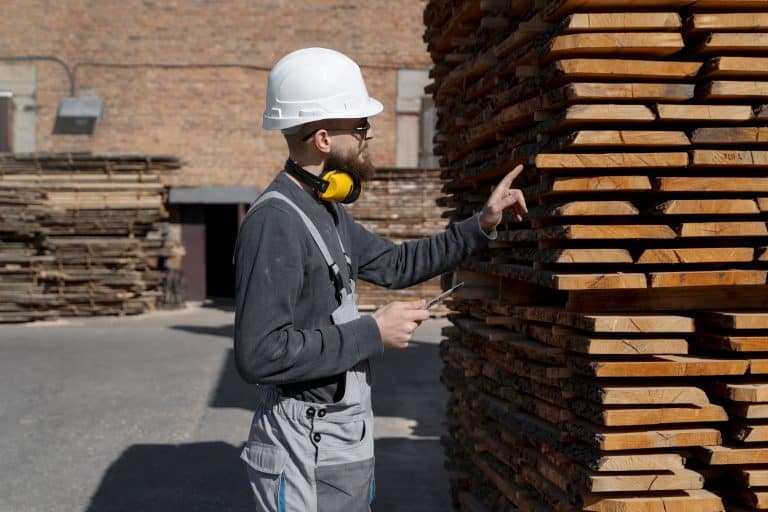
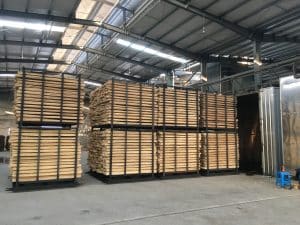
The “Net Capacity” is also influenced by how you stack your lumber. Proper stacking ensures uniform airflow, which is essential for consistent quality.
Sticker Thickness: Stickers typically take up 15–20% of the vertical stack space.
Airflow Plenums: You must leave 600 mm- 1000 mm of space between the wood stack and the walls to allow fans to circulate heat evenly.
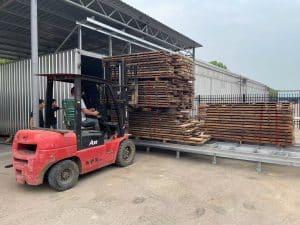
Loading Method: Forklift-loaded kilns require wider doors and specific internal clearance compared to track-and-trolley systems.
5. Why Multiple Small Kilns Often Beat One Large Kiln
Instead of one massive 200 m³ kiln, installing four 50 m³ kilns offers significant advantages:
Species Flexibility: Dry Oak in Chamber 1 while drying Pine in Chamber 2.
Energy Management: Staggering the “Heating Phase” reduces the peak load on your boiler or heat pump.
Risk Mitigation: If one kiln requires maintenance, your entire production line doesn’t stop.
Rolling Schedule: Load and unload one chamber every few days to keep your workflow steady.
6. Boosting Efficiency with Smart Automation
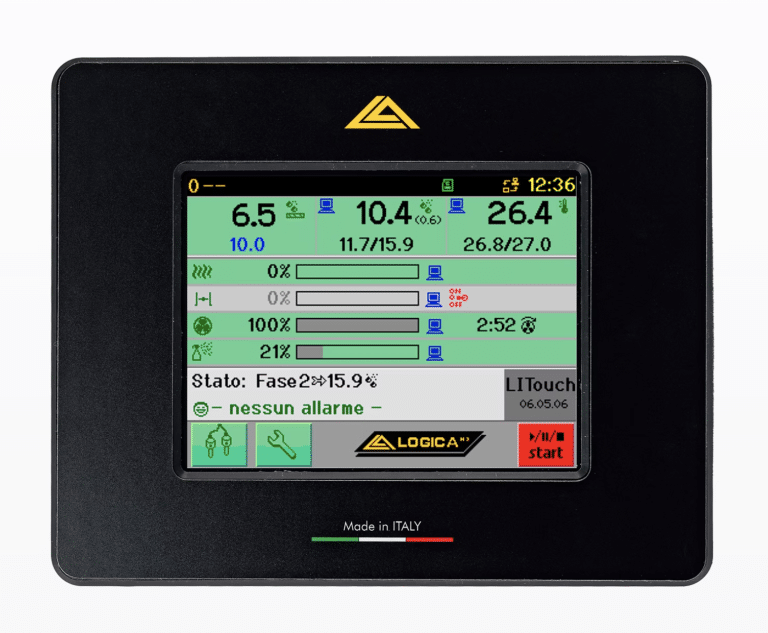
At Hangzhou Tech Drying, we utilize Italian automatic control systems to maximize your kiln’s efficiency and ensure precision drying for high-value timber.
Up to 30 Drying Stages: Our controllers manage complex, multi-stage cycles. This allows for extremely gradual transitions in temperature and humidity, preventing internal stress in sensitive hardwoods.
80 Preset Drying Schedules: Jumpstart production with 80 built-in professional programs. Whether drying 25mm Pine or 75mm Teak, the optimal parameters are ready at the touch of a button.
PC & Remote Cloud Monitoring: Monitor moisture content and kiln status directly from your office PC. By knowing exactly when a batch reaches its target MC, you can schedule unloading immediately, minimizing “dead time” between batches.
Summary Checklist for Buyers
Before requesting a quote, have these numbers ready:
Daily target output (m³).
Wood condition: Will you load Green-off-saw or Pre-dried lumber?
Species and thickness (e.g., 50mm Oak).
Available heat source (Steam, Biomass, Heat Pump, or Electric).
Get a Professional Capacity Assessment
Selecting the right industrial lumber kiln capacity requires technical expertise. At Hangzhou Tech Drying Equipment, we provide custom layouts and energy ROI analysis tailored to your specific wood species and climate.
Contact Our Engineering Team Today for a free consultation on your next drying project.